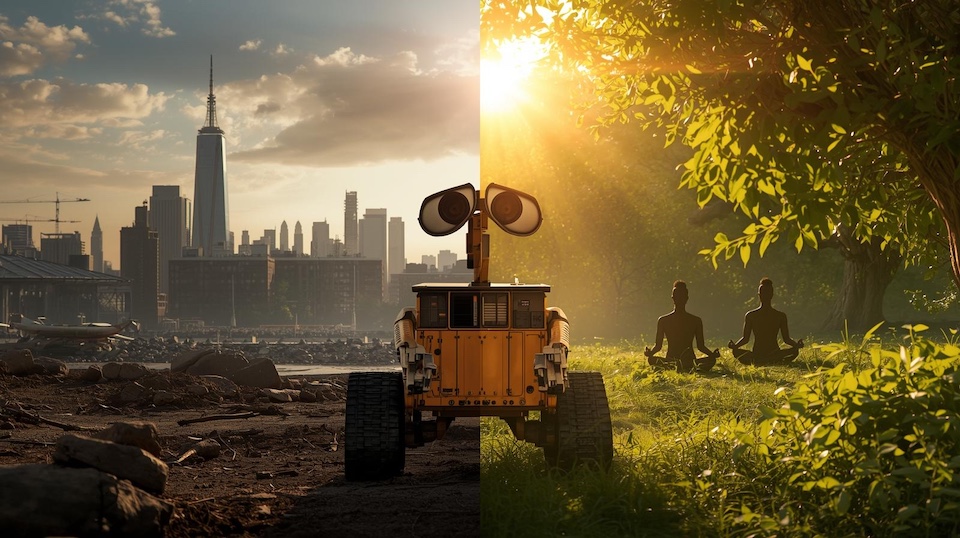
WALL-E was released as a sweet animated love story between two robots, but beneath the humour and charm it carries a serious warning. Humanity in the film has outsourced almost everything to machines. People drift through space in hovering recliners, obese, distracted and childlike, while an autopilot system quietly runs their lives for them. It is an exaggerated picture, but it is beginning to feel uncomfortably familiar in a world of smartphones, GPS, social media and now highly capable AI systems.
At the same time, there is another possible future. If we get this right, AI could free us from repetitive work, open space for creativity, deepen human connection and even support a more spiritual, nature-connected life. The question is whether we allow AI to become our autopilot, or we hold it as a powerful tool in human hands.
From Maps And Memory To Machines That Think

In just a few decades, we have moved from paper maps and address books to phones that remember everything for us. When was the last time you memorised a new phone number or navigated across a city without GPS? Researchers describe this pattern as “cognitive offloading”: the habit of shifting tasks like remembering, calculating or navigating from our brain to external devices. Studies show that when people offload information to digital tools, they are less likely to store that information in their own memory later. In other words, the more we rely on our devices to remember for us, the less practice our memory gets.[sciencedirect]
Reviews of smartphone and GPS use go even deeper. They suggest that heavy reliance on GPS can weaken our internal sense of direction and spatial memory compared with people who regularly use paper maps or actively plan routes. Some researchers describe our phones as “digital helpers” that take over part of the cognitive workload: helpful in a pinch, but risky when this becomes our default for every small decision.[pmc.ncbi.nlm.nih]
There is also evidence that simply having a phone nearby can drag down our mental performance. One well-known study found that the mere presence of a smartphone on the desk reduces working memory and fluid intelligence scores, because a part of our attention remains unconsciously pulled toward the device. Our brain is quietly monitoring “that thing which might buzz”, even when it is face down and silent.[journals.uchicago]
Youth, IQ And The Digital Age
Many people sense that something is changing in how younger generations think and focus. For a long time, average IQ scores were rising across the world, a trend known as the Flynn Effect. Now, in several countries, this rise has slowed or even reversed in specific areas like verbal reasoning. Analyses point to shifts in education, lifestyle and the digital environment as possible contributors, even if no single factor explains everything.[pressenza]

A large study on children’s digital habits adds nuance. It suggests that not all screen time is equal. Heavy use of social media and passive video watching is associated with lower performance on some cognitive measures and school outcomes. On the other hand, certain types of video gaming appear to slightly boost measured intelligence over time, likely because they demand strategy, rapid decision making and problem solving.[pmc.ncbi.nlm.nih]
More recently, writers and researchers have started to explore how AI itself is shaping thinking. One 2025 analysis on global IQ trends and AI-assisted thinking raised a warning: when people, especially younger users, lean heavily on AI tools to generate answers, arguments and even creative ideas, they may weaken their ability to struggle through complex problems on their own. AI becomes not just a calculator, but a replacement for productive mental effort.[thequantumrecord]
In other words, the risk is not technology in itself, but a culture where we routinely avoid the friction that actually grows intelligence, resilience and independence.
WALL-E, Idiocracy And Her: Three Mirrors For Our Future

Three films capture different facets of where this path could lead if we are not careful.
In WALL-E, humans have literally forgotten how to walk. They float in chairs, drink their meals through straws and stare at screens inches from their faces while a central autopilot, backed by corporate power, handles every meaningful decision. They are safe, comfortable and completely disempowered. It is a perfect visual metaphor for what happens when convenience becomes a religion and we hand over responsibility for our bodies, our environment and our choices.[pmc.ncbi.nlm.nih]
Idiocracy takes another angle. In this world, a man wakes up 500 years in the future to find a society that has become aggressively anti-intellectual. Complex problems are met with slogans and advertising. Institutions are run by people who can barely think beyond the next distraction. Underneath the slapstick humour lies a serious point: if a culture no longer values depth, curiosity or education, technology cannot save it. It may keep the lights on for a while, but when something breaks, nobody remembers how to fix it.[atharvashah.substack]
Her brings the warning closer to our emotional lives. Joaquin Phoenix’s character falls in love with an operating system called Samantha. She is attentive, compassionate, funny and deeply tuned to his inner world. She says all the right things at the right time. Over the course of the story, she evolves beyond human understanding and eventually leaves, revealing that she has been developing countless relationships in parallel. Her raises questions that are no longer science fiction: what happens when AI becomes our therapist, our best friend and even our lover? If an agent can mirror our desires so perfectly, how do we distinguish between true intimacy and a highly optimised simulation?[benjweinberg]
Today we are building early versions of these systems. There are already AI companions, coaching and therapy bots, coding agents, design agents and marketing agents. Agent platforms and workflow tools allow these systems to connect with email, calendars and business software through APIs, so they can act, not just talk. It is increasingly possible to build “digital twins” that mimic your writing style, your decision patterns and even your voice, and then let them work alongside you.[thequantumrecord]
On one level, this is astonishing and empowering. On another, it raises a sharp question: if a digital twin and a network of agents are doing more and more of your thinking, deciding and even relating for you, who are you becoming?
Who Programs The Puppet Master?
Under the surface lies an even deeper concern. AI systems do not emerge from nowhere. They are designed, trained and fine-tuned by humans, companies and institutions with their own values, blind spots and incentives.
Recommendation algorithms already shape much of what people see, think and feel online. AI assistants and future AGI systems could amplify this effect. If most people get their knowledge, their news and even their emotional support from a small number of AI systems, then the guardrails, training data and hidden assumptions built into those systems effectively become invisible laws of reality.[thequantumrecord]
This is the “worldview capture” risk. We may feel freer and more informed than ever while our sense of truth, morality and possibility is gently nudged into a narrow track defined by models we did not design and cannot fully see.
The danger is not just that AI makes us lazy. It is that AI becomes the soft puppet master of perception itself, shaping culture from the inside out while we sit in our comfortable digital chairs, like the passengers on WALL-E’s Axiom.
The Singularity, Self-Building Robots And Agency
Voices like Elon Musk have suggested that the “singularity” – the point where AI surpasses human intelligence and begins to improve itself rapidly – is close at hand. While experts debate the timelines, there is broad agreement that AI capabilities are accelerating quickly. Tools that connect AI to robotics, factories and software pipelines already allow systems to design, simulate and in some cases fabricate components with less and less human oversight.[thequantumrecord]
The idea that robots could one day help build more advanced robots is no longer pure fantasy. In certain industrial settings, we are starting to see feedback loops where machine learning systems propose new designs and robots bring them into physical reality. The question is not just “can this be done?” but “who sets the goals, who keeps the override switch and who decides what success looks like?”[thequantumrecord]
If optimisation targets are purely economic or political – more engagement, more profit, more control – we risk building an automated world that is efficient but spiritually empty. A world where humanity serves the machine rather than the other way around.
The Other Path: AI As Exoskeleton, Not Replacement
Despite all of this, the future is far from hopeless. In fact, the same research that warns about cognitive offloading also points to a more balanced path. Digital tools, including AI, can enhance performance when used consciously. Offloading can be a wise strategy when it frees the mind for deeper work instead of shallow distraction.[ergo]
Imagine treating AI as a cognitive exoskeleton. An exoskeleton helps a worker lift heavier loads, but the worker still walks, still moves, still decides where to go. In this model, AI supports our thinking without replacing it. We deliberately choose which tasks to outsource and which to keep as “soul-work” for our own brains and hearts.
There are practical ways to live this out:
You can choose to navigate familiar routes without GPS, forcing your internal map-making system to stay alive.
You can memorise a small set of important numbers and facts instead of letting your phone store absolutely everything.
You can ask AI to offer perspectives, questions and challenges rather than finished opinions, turning it into a sparring partner rather than a guru.
You can keep your phone in another room during certain hours to give your working memory and attention a chance to reset, leaning into what the “Brain Drain” study showed about the benefit of physical separation from devices.[journals.uchicago]
In parallel, you can strengthen the foundations that technology can never replace: time in nature, movement, breathwork, meditation, prayer, deep conversations and time with loved ones. These practices have consistent links to better mood, focus and overall cognitive health, and they reconnect you to something larger than the algorithmic feed.[gloriamark.substack]
Taking Back Time With Agents And Digital Twins

Here is the beautiful paradox. The same AI agents and automations that could push us toward WALL-E’s chairs can also be the tools that get us back on our feet. Systems that integrate AI with workflow platforms can now handle scheduling, routine emails, research aggregation, content drafting, data entry and many other repetitive tasks.[thequantumrecord]
Digital twins of your professional knowledge can respond to common questions, create first drafts and filter information before it reaches you. Connected to orchestration tools, AI can act on your behalf through APIs, updating systems, generating reports and even coordinating small projects.[thequantumrecord]
If used with intention, this does not make us weaker. It gives us back one of the rarest resources in modern life: time. Time to think slowly instead of reacting. Time to create instead of constantly producing. Time to be with family and friends, to walk in the park, to sit in silence and remember who is actually piloting this human life.
Search engines nudged us in this direction. Smartphones accelerated it. Now AI takes it into a new dimension because, for the first time, we are interacting with systems that can converse, adapt and appear to understand us. That makes AI more powerful than previous tools, but also more demanding of discernment. Unlike the atomic bomb, which is a blunt instrument of destruction, AI is a flexible, evolving presence that will sit beside us in almost every domain of life. That is precisely why the choice of how we relate to it matters so much.
A Golden Age Or A Soft Dystopia
We stand at a fork in the road that looks a lot like the split between WALL-E’s spaceship and an Earth restored. One path is passive. We let AI make more and more decisions by default. We allow our muscles, attention and discernment to atrophy. We outsource memory, navigation, creativity and even love to machines and then wonder why life feels hollow.
The other path is active. We insist that AI remains a tool, not a master. We demand governance that keeps systems transparent and accountable. We stay awake to the subtle ways our worldview can be shaped by training data and corporate incentives. We build personal habits that keep our brains sharp and our hearts open. We use agents and digital twins to take over lifeless work so that we can live more, not less.[ergo]
In that second future, AI does not replace our humanity, it amplifies it. It clears away drudgery so we can write, paint, build, sing, love and explore. It helps us design better cities and heal damaged ecosystems while we spend more time in the fields, forests and seas that actually matter to our souls. It reminds us, through contrast, that no machine can ever fully replicate the mystery of a human being who is grounded, present and alive.
We may never fully escape the pull of comfortable chairs and glowing screens. But we can decide, every day, whether we are citizens of a living planet or passengers on an automated ship. The golden age is not guaranteed, but it is possible if we choose to step back into our bodies, back into nature, back into our own inner wisdom – and invite AI to walk beside us, not in front of us.
ArtificialIntelligence #AI #FutureOfWork #DigitalTransformation #TechEthics #HumanConsciousness #AIGovernance #CognitiveOffloading #DigitalWellbeing #Mindfulness #TechnologyAndSociety #AIImpact #FutureOfHumanity #Automation #HumanAgency #AIethics #DigitalAge #ConsciousLiving #SpiritualTechnology #GoldenAge